In the world above, the people "with unnatural smiles" are those who spend their time trying to rectify their errors. Why wouldn't they be the most content instead?
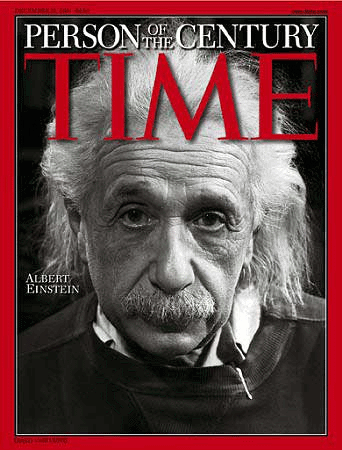
History proves that human kind is a race prone to selfishness and injustice. When man has the chance to redeem himself for a wrong action they usually take full advantage of the opportunity, disregarding the circumstance. In this certain dream of Einstein, Lightman imagines a world where the people know exactly when time is going to end. "These days people are polite when they order their bread. They smile and pay promptly..."(Lightman 43) for they know that the world is ending soon and they have chosen to live the little time they have left free of anxiety and pain, rather fill of jovial joy. However “a few souls gallop through the street doing good deeds, attempting to correct their misdeeds of the past"(44). These few souls, apart from the rest in the world, are thinking beyond the reality that this little time left is painting calm, unified, and friendly world but more of their fate after life. Instead of naturally being friendly and valuing others while they have the time, they unnaturally smile as they mend each mistake of their past. Their contentment lies in their selfish satisfaction. The "few souls" demise that by effortlessly doing good deeds with the benefit of them in mind that they will have cleaned their plate just in time for the world to end. However, by unjustly fixing their past they are only tarnishing the present with selfish deeds of redemption.
By law of the Christianity, in order to fully be forgiven for a wrong action, God has to see by himself that you are truly sorry and your penance is true and not for any other reason but your apology. Thus a good deed by the "few souls" should be out of forgiveness and not redemption. They have had all their lives to correct their mistakes and now they are waiting till the very end to change everything. Their intentions are for the sake of their fate and life after life. Their half smiles are a result of their false intentions and we should look at them as an example that their is never enough time thus we should take advantage of the air we are breathing now and not wait till the very end to breath again.
Word count: 377
By law of the Christianity, in order to fully be forgiven for a wrong action, God has to see by himself that you are truly sorry and your penance is true and not for any other reason but your apology. Thus a good deed by the "few souls" should be out of forgiveness and not redemption. They have had all their lives to correct their mistakes and now they are waiting till the very end to change everything. Their intentions are for the sake of their fate and life after life. Their half smiles are a result of their false intentions and we should look at them as an example that their is never enough time thus we should take advantage of the air we are breathing now and not wait till the very end to breath again.
Word count: 377


4 comments:
I believe also, Amanda, that the contentment of those with unnatural smiles "lies in their selfish satisfaction." If they were not compelled by imminent disaster, would they feel obliged to atone? Should circumstance alone instigate atonement? I hope not. As Einstein believes in an ideal of service to our fellow man, your post serves an ideal of atonement not compelled by impending doom, but by empathy for our fellow man. I think Lightman might smile a natural smile.
But should we laud the others who are simply "polite when they order their bread," who "smile and pay promptly?" Should they be doing more with the precious time left? What would be left to do?
These seem intractable questions, though at the same time questions that cannot go unanswered in our own lives.
10/10
So did you like it or not? "As Einstein believes in an ideal of service to our fellow man, your post serves an ideal of atonement not compelled by impending doom, but by empathy for our fellow man. I think Lightman might smile a natural smile." ???
Golly. I thought my comments were resoundingly positive; indeed, I thought they would make Lightman smile! But to be clearer than clear: yes, I liked it very much.
Amanda, this is not a direct hit (nor is anything that I do a direct hit) on you, so do not take it personally. I think that we disagree on this point, and Mr. Ehret told me to look at your blog so that I could understand what he was trying to explain to me.
Mr Ehret,
I truly cannot understand how you could write "If they were not compelled by imminent disaster, would they feel obliged to atone?" How can you not respect the fact that each human has a conscience and that these men may have been listening to their consciences and wanted to apologize for their misdeeds BECAUSE their consciences told them to, not because of the imminent disaster. I know that Amanda's idea is supported by the text, but the text only holds Lightman's ideas and show what he is trying to show. If you take it a step further, and try to think for yourself, the people were unhappy that such a tragic event was about to occur. This tragic even was the impetus that SPARKED apologies and remorse. Their smiles may have been "unnatural," but they were unnatural because they had to apologize in a much quicker way and very unexpectedly.
PEOPLE MEAN GOOD!
Unsincerely,
Ian
Post a Comment